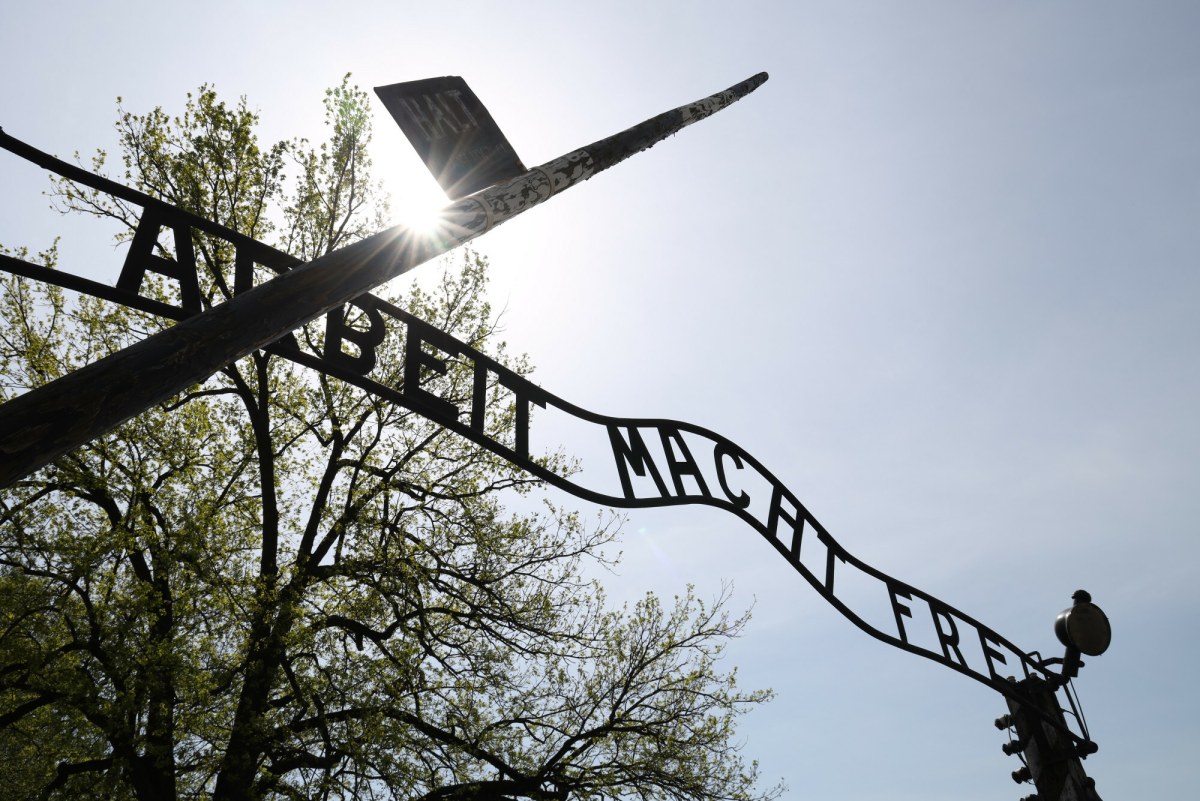
Every year in mid-April, thousands of people walk the short distance from what was erstwhile the Nazi concentration camp of Auschwitz I to the death camp of Auschwitz II–Birkenau. They commemorate the victims of the Holocaust through the “March of the Living”, waving flags, singing songs, and praying, showing that there are inactive people who care. Nowadays 1 walks along a recently constructed main road, with the surroundings almost completely empty and police stationed on all corner. Politicians and delegations from all over the planet march at the front, flown in just that morning, escorted by safety details, posing for pictures and laying flowers.
Close to the end of this procession you find me, working as a guide for this year’s Austrian “Morah” initiative, scolding students who do not behave appropriately. any groups are loud, almost in a organization mood, but the ones toward the end, especially those from countries erstwhile integral parts of the Nazi state, are expected to show their regret and to approach this as a quiet, ceremonial act.
Morah, besides known as the March of Remembrance and Hope, is an global initiative focused on educating young adults through memorial trips to Poland, specifically to Auschwitz, and participation in the march. Each year, dozens of schools from Germany and Austria take part, each sending around forty to 50 17-year-olds along with 2 teachers and 1 or 2 specialized tour guides to Kraków. Together with my partner, we service as those guides, being there for the students, always up to date on the agenda, and always ready to perceive and help.
These remembrance trips have developed into a central component of historical and civic learning in many countries. At an global level, Holocaust education emerged more clearly in public and academic discourse in the final decades of the 20th century. global frameworks, specified as the IHRA Recommendations for Teaching and Learning about the Holocaust, supply applicable guidance for educators. In Germany and Austria, a key minute in this improvement was the broadcast of the American tv series Holocaust in the late 1970s. Although fictional and sometimes criticized for its melodramatic style, the series had a crucial cultural impact. After 1945, Austria built its identity on the thought that it had been “the first victim” of Nazi Germany. This has been described as the “victim myth”. The school strategy played a key function in spreading this idea. In the years after the war, education focused powerfully on constructing a fresh Austrian identity far removed from Nazi ideology. Since then, Holocaust education in countries like Austria, where I grew up, has become institutionalized within formal education systems and is closely linked to visits to memorial sites, survey trips, and encounters with historical locations specified as Auschwitz. The problem with this educational model is that all country, region, and even school has, to any extent, varying levels of cognition about Holocaust memory and even more so about judaic culture itself. Cultural and societal context, as well as biases in remembrance, are seldom acknowledged in formal education.
Even I went on specified a journey during my school time, not through an organization but solely organized by a teacher who happened to be Polish. In my class, most people were of Austrian origin. Anyone with a migration background was rare. My parent fled Poland in the 1980s and raised me by herself, in a very conventional Polish household. Officially no 1 in my household is judaic but both my large grandmothers were sent to Auschwitz. I was the only 1 in my group who had any kind of past or ties to Poland and its judaic history. This led to a rather complicated situation. On 1 hand, everyone kept asking me all fewer minutes while visiting Auschwitz if I was okay. On the other, no 1 cared to actually talk about their feelings before and after, especially not with me, since they were besides guilty about what their ancestors had done.
The second time I visited was years later together with my partner, who is Jewish. Oświęcim, the town adjacent to the camp complex, had changed rather a bit. A buying centre was being built and there are noisy streets, as well as respective adverts for Oświęcim as a new, attractive place to move. The group joining us on the tour had almost no cognition of the Holocaust. They posed with selfie sticks on the train tracks in Birkenau, while my partner squeezed my hand always so tightly.
This year we were expected to travel as educators, stepping in at the last minute as a favour to our friend. Both of us were more than qualified: I am the only guide who is simply a Polish talker and has researched and studied the region for years, and my partner is simply a certified antisemitism coach. Early in the morning, we got on the bus and were taken straight to the Auschwitz memorial site, without stopping at the hotel and with no workshop to prepare our group for the visit. We effort our best to talk to the students on the bus, but most of them are, understandably, more curious in treating the ride as any another school trip.
At a petrol station, a local man asks curiously where we were headed. I explain that this is simply a school journey to Auschwitz and he responds: “Auschwitz? Only Jews go there… are you guys Jewish?” I let out a tense laughter and say of course not. He nods and adds, “Good, due to the fact that only judaic people belong there.”
As our bus misses the exit on the highway, we arrive almost an hr late and are immediately escorted to our guide, who gives us a shortened tour so we can inactive make dinner in time at the hotel. During the tour, there is simply a strong emphasis on Austria’s function as a major contributor to the Nazi regime. It is contrasted with the communicative of a “glorious Polish nation that helped all its judaic citizens”. It is crucial to note here that in Poland, Holocaust memory is closely tied to broader debates about national identity, wartime suffering, and moral responsibility. A key feature of Polish Holocaust memory is the tendency to prioritize narratives of Polish national suffering over the specifically judaic experience of genocide. By merging these experiences into a single communicative of “shared suffering”, public discourse can unintentionally shift attention distant from the specificity of the genocide of Jews. As a result, the Holocaust is sometimes remembered mainly as part of the Polish national tragedy, alternatively than as a separate genocide targeting Jews. This bias was not discussed during the tour.
The next day starts early with a talk between our students and any judaic teens their own age. The “Likrat” programme is an Israeli youth initiative that brings judaic and non-Jewish teenagers together for dialogue. It rapidly becomes clear that the Austrian students have quite a few cognition erstwhile it comes to the past of the Second planet War, but have practically no cognition of judaic culture and history. After a long discussion, 1 of the judaic students says, after a brief pause, that it would be okay to talk about Israel and Palestine, the conflict in Gaza, and to exchange their thoughts. Although any students the erstwhile day considered not attending the march due to the number of Israeli groups and flags there, the crowd is silent. No 1 truly feels able to talk about this openly, frightened to cross boundaries and unsure of what to say exactly.
Afterwards, our group makes its way to Auschwitz again, prepared with jackets, and banners. The atmosphere in the museum is relaxed, the sun is shining and most attendees sit on the grass next to the old buildings, eating, talking, laughing. It has not even been 24 hours since we visited, but the full vibe has changed; 1 almost forgets that this is the place we walked through in silence a day earlier.
After hours of waiting, our group yet starts the walk towards Birkenau. Israeli groups hand out badges, stickers, and bracelets, trading them with everyone. The students and guides from Austria grin politely and make tiny talk but rapidly put distant any gifts that include the Israeli flag into their pockets. An orthodox hebrew spots my partner and asks him to do a prayer and put on the tefillin. It becomes a symbolic minute for both, praying openly and visibly 80 years after the Nazi government killed millions, including around 1 million on this dirt where they are standing. Afterwards any of our fellow tour guides come up to him and ask what that was about, having no thought how judaic prayer works.
By the time we arrive in Birkenau the ceremony is nearing its end. Hundreds of people walk the grounds. The usually vast and eerie place is now filled with people, changing its full atmosphere. During the Kaddish prayer I have tears in my eyes, abruptly profoundly touched by all the judaic grief, but there is no time to digest it, since we are behind agenda yet again.
One student almost jokingly asks about the weirdly shaped buildings on the horizon. I tell them that everything was destroyed to cover up traces but that these were the crematoria utilized to burn bodies until the very last minute. He stops and remains quiet for the remainder of the day. That is the biggest issue on this trip: you forget the weight of the subject due to all the organizational issues, and abruptly it hits you all at erstwhile and you are not able to breathe.
Our final day was besides packed. A city tour through Kraków’s judaic territory of Kazimierz is followed by a performance in 1 of the 2 synagogues inactive utilized by the community. There is no time to truly visit the city itself or learn about its past in a way that contextualizes everything we had seen and experienced over the last 2 days. During the concert, the cantor encourages the crowd to sing along, clap and dance. We take students by the hand and dance together in a circle. Chaos and laughter are everywhere. Afterwards, a girl comes up to me, very amazed that Judaism is not only about grief and sadness.
On our way back, we talk to the students’ teachers. 1 of them has been doing this for over 10 years, saying that visits to Auschwitz never get easier, but that he inactive finds it crucial to do so. The programme, he tells us, has not changed much since then, but any years are better than others. We share our disappointment, talking about the limited space for reflection and the deficiency of cognition about judaic culture and history.
He asks me if I want to be a guide again next year. I hesitate, due to the fact that I am dissatisfied with the structure and the educational part of the memorial journey itself, but I besides feel liable to effort to make it better, even if it is only by myself and by changing 1 person’s mind. Ultimately, my experience with the March of the surviving exposed a central contradiction: while the programme is intended to foster remembrance and education, its structure frequently reduces reflection to logistics and symbolism, leaving small space for meaningful engagement with judaic history, cultural complexity, or the emotional and ethical weight of what is being commemorated. due to the fact that Holocaust memory is not something of the past, and in cities like Vienna, Kraków, or Berlin, where I live now, 1 can feel the remains of judaic past everywhere, all day.
Viktoria Rybicki is simply a Berlin-based investigator focusing on populism and memory culture. She now manages the Claims Conference Berlin office, having previously worked as an intern at fresh east Europe and the Galicia judaic Museum in Kraków and continues to work as a freelance journalist.
New east Europe is reader-supported. If you value independent coverage of Central and east Europe, delight consider supporting our work.
Click here to donate.